
There are families living with a side of autism that rarely makes its way into everyday conversations.
I'm not talking about an occasional meltdown or a difficult afternoon. I'm talking about violent outbursts that involve punching holes in walls, throwing furniture, destroying property, or physically hurting the people closest to them.
For some families, this is happening behind closed doors, sometimes with adult children who are bigger and stronger than the parents caring for them.
There can be fear, exhaustion, injuries, and uncertainty about what might happen next. There can also be tremendous love for the person at the center of it all.
Those feelings are not mutually exclusive.
What if some of the emotional burdens an autistic child or adult carries are adding to the intensity of what they're experiencing?
There May Be More Going On Than We Can See
Serious aggression in autistic adults can involve several contributing factors, and those factors aren't necessarily the same from one person to another.
Physical discomfort or chronic pain, sensory overload, difficulty communicating needs, anxiety, emotional regulation challenges, changes in routine, and co-occurring conditions can all be relevant. ADHD, for example, can introduce additional difficulties with impulsivity and self-regulation.
The UK's National Institute for Health and Care Excellence (NICE) recognizes these complexities in its clinical guidance for autistic adults, recommending that physical health, sensory environments, communication, coexisting conditions, and changes in circumstances be considered when evaluating challenging behavior.
I mention these factors because I understand that serious aggression is not a simple problem with a single explanation. Families may already have spent years exploring many of these possibilities with healthcare professionals.
However, there's another possibility I want to introduce.
What about the emotional baggage a person has accumulated throughout life?
Emotional Baggage Doesn't Disappear Just Because We Can't See It
Think about the emotional experiences people carry.
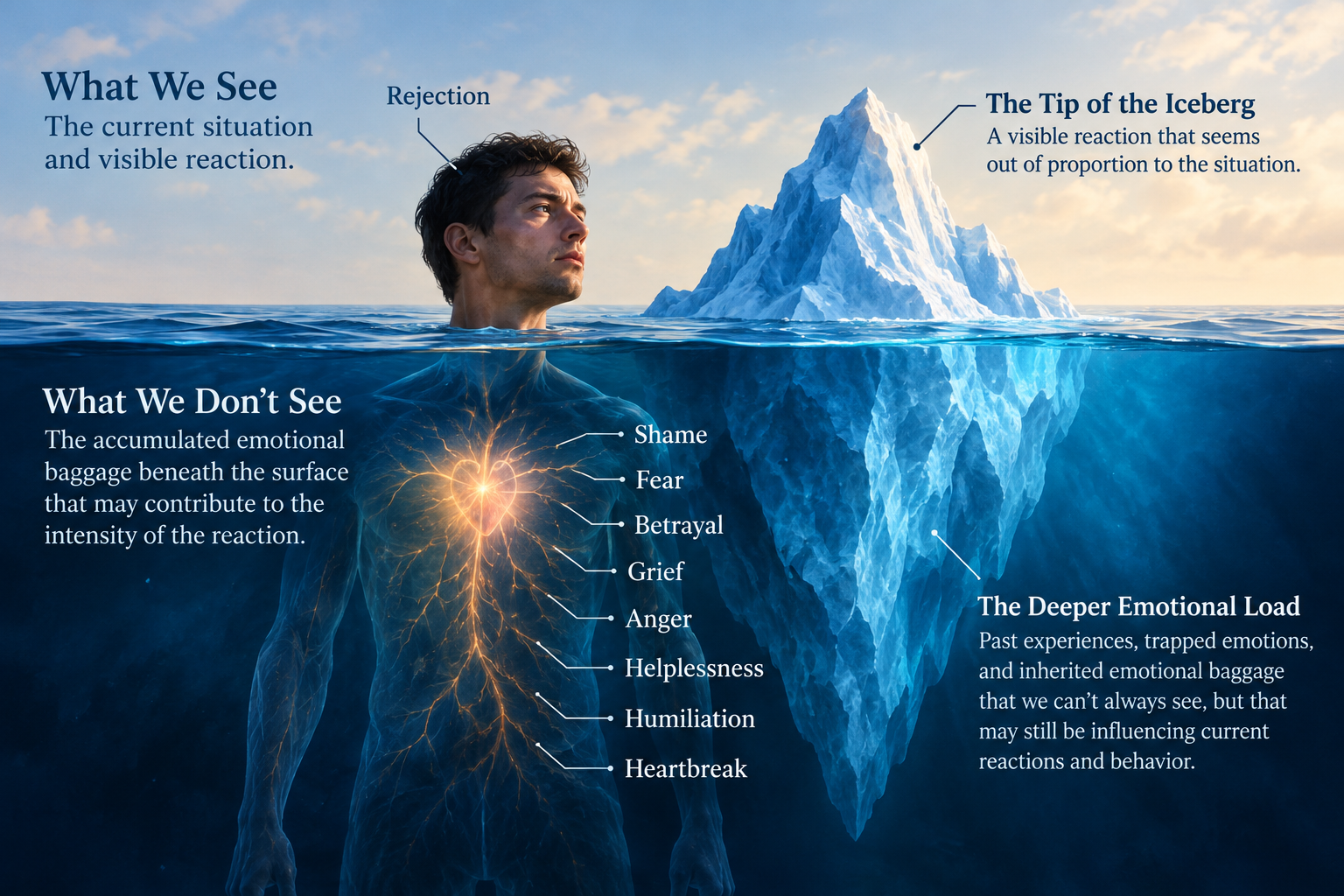
Anger. Fear. Grief. Rejection. Humiliation. Heartbreak. Helplessness. Betrayal.
Some experiences happened decades ago, yet certain situations can still trigger surprisingly intense emotional reactions.
Within the Emotion Code, developed by Dr. Bradley Nelson, we work with what we call “trapped emotions.”
Emotions have an energetic component, and the Emotion Code is based on the understanding that when we experience something emotionally overwhelming, the body may not fully process that emotional energy. Instead of passing through us, some of that energy may become stuck or trapped within the body and its energy systems.
These trapped emotions may remain long after the original experience has passed, sometimes for decades. They may contribute to emotional triggers, physical discomfort, or reactions that seem unusually intense compared to the circumstances.
For example, someone may experience anger during a painful event twenty years ago, yet still carry the emotional charge associated with that experience today.
The Emotion Code also addresses inherited trapped emotions, which are believed to be passed down through generations. This means the emotional baggage we explore isn't necessarily limited to experiences from a person's own lifetime. We were born with a certain amount of emotional baggage that didn’t even originate with us.
As a Certified Emotion Code practitioner, I use muscle testing to identify these potential emotional imbalances and then release them.
What interests me is the possibility that a person's current reaction may involve more than the event happening in front of them.
Sometimes the immediate trigger is only the tip of the iceberg.
The trigger may be small, but the total accumulated emotional charge behind the reaction may be enormous.
A Man With Back Pain, Road Rage, and Twenty-Year-Old Anger
Dr. Bradley Nelson shared a fascinating example during an interview with Lewis Howes.
A man came to him with severe back pain. During the session, Dr. Nelson identified trapped anger connected to an incident approximately twenty years earlier, when the man had been falsely accused of financial wrongdoing.
After the emotion was released, the man reported that his back pain disappeared.
However, the more interesting part of this story, for our purposes, came several days later.
The man returned and explained that he had struggled for years with road rage, marital arguments, and intense anger. He had even attended anger management classes.
Since the session, situations that previously triggered his anger no longer produced the same reactions.
Dr. Nelson hadn't even known about those anger problems when he worked with him.
The circumstances hadn't necessarily changed. The emotional charge associated with them had.
I've experienced changes in emotional reactivity through releasing trapped emotions myself.
What If Someone Experiences That Same Emotional Burden More Intensely?
Consider the man in Dr. Nelson's story.
He was carrying anger connected to an experience that had happened twenty years earlier. According to his account, that emotional burden appeared to affect how he reacted to situations that might not otherwise have provoked such intense responses.
Now imagine an autistic adult carrying a similar emotional burden.
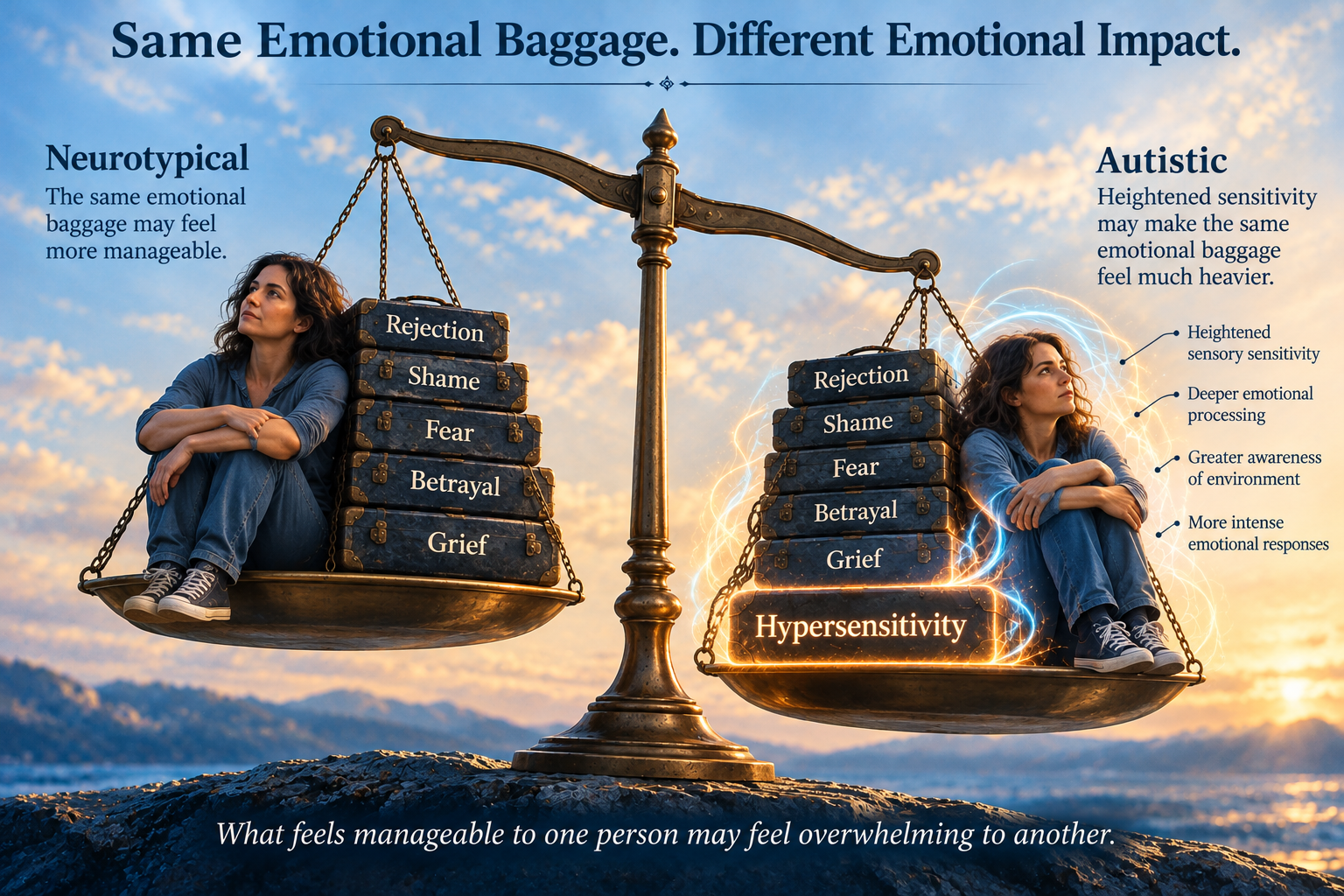
What if that person experiences certain emotions or sensory inputs far more intensely?
What if they also struggle to regulate those intense feelings, communicate what they're experiencing, or explain that something hurts?
What happens when frustration, physical discomfort, fear, or sensory overload is added to an already overwhelming emotional burden?
An equal emotional burden may not be an equal emotional experience.
We can observe someone's reaction without necessarily understanding the intensity of what they're experiencing internally.
Before deciding that a reaction is disproportionate to the situation, perhaps we should consider whether we truly understand how that situation feels to the person experiencing it.
That brings me to the question I really want to ask.
Why Aren't We Exploring Emotional Baggage for Autistic Adults, Too?
An autistic adult doesn't stop being a person with an emotional history simply because they experience or express emotions differently.
They can experience rejection, loss, grief, fear, frustration, disappointment, and heartbreak.
They can have painful memories and emotional experiences they cannot easily explain to another person.
They may also be carrying inherited trapped emotions from generations before their own, adding another potential layer of emotional baggage beyond their personal experiences.
If releasing trapped emotions appeared to help the man in Dr. Nelson's story become less reactive to situations that once provoked intense anger, could exploring similar emotional burdens offer something meaningful to an autistic adult?
What if there were less emotional baggage adding to their distress?
What if the next frustrating or overwhelming experience didn't have quite as much emotional charge behind it?
What if they felt more comfortable within themselves?
I believe those questions are worth asking, particularly for individuals who may have difficulty telling us what they're feeling.
Autism doesn't make someone immune to the emotional baggage that comes with being human. If anything, the challenges of navigating a world that doesn't always understand them may give them even more to carry.
Consider someone who experiences rejection, fear, frustration, or helplessness but struggles to communicate what happened or how it made them feel. They may not have the words to explain their distress, ask for emotional support, or even help someone recognize that something is wrong.
That doesn't mean those experiences haven't affected them.
We don't expect neurotypical people to go through life without accumulating emotional baggage. Why would we assume autistic individuals are any different?
They deserve the same opportunities for emotional support, even when they cannot tell us what they're carrying.
They Don't Have to Tell Me What's Wrong: How Remote Proxy Sessions Work
One of the things I appreciate most about the Emotion Code, Body Code and Belief Code is that my process does not require a client to verbally explain their experiences.
I work remotely by proxy, using muscle testing to explore potential trapped emotions and other energetic imbalances.
That means an individual doesn't need to describe a painful memory, answer questions about their feelings, or sit through a conventional appointment.
For an autistic adult who depends on familiarity and routine, this approach has some practical advantages.
There is no unfamiliar office to visit, no travel to arrange, and no need to interrupt their usual environment for a session. I can conduct my work remotely, even when the individual lives on the other side of the world.
My focus is on exploring possible emotional and energetic burdens, not requiring the individual to communicate in a way that may be difficult or unavailable to them.
The Goal Is Emotional Relief, Not Control
I want to make something very clear.
My goal is not to control an autistic individual.
I'm not trying to make someone obedient, change their personality, or make them easier for other people to manage. I'm certainly not trying to cure autism.
My interest is in their emotional health and well-being.
If someone is carrying emotional baggage that may be contributing to their internal distress, I want to explore whether some of that burden can be eased.
Of course, I also hope that feeling less emotionally overwhelmed might translate into fewer or less intense outbursts.
Their emotional well-being comes first. If that relief happens to result in fewer, less intense outbursts, that's a win-win.
Another Avenue of Support Alongside Appropriate Care
I believe this work is worth exploring as a complementary approach alongside appropriate medical and professional care.
My role is not to diagnose medical conditions, replace established treatment, or assume responsibility for managing dangerous behavior or complex medical needs.
I offer a specific type of energy work focused on exploring potential emotional and energetic imbalances. Whether that work is appropriate for a particular individual is something we can discuss before proceeding.
My intention is to contribute to their well-being while respecting the care and support already in place.
What If There's One Less Burden for Them to Carry?
I can't promise you that releasing trapped emotions will resolve violent outbursts in an autistic adult. What I can tell you is why I believe this possibility deserves exploration.
I've experienced meaningful changes in my own emotional reactivity through this work. Dr. Nelson's account of the man who struggled with back pain and anger illustrates the kind of change I would love to see more people have the opportunity to experience, especially those who may be suffering in silence.
An autistic adult has an emotional history just like anyone else. They may carry grief, fear, rejection, anger, heartbreak, and other emotional burdens that deserve attention, even when they cannot put those experiences into words.
Why should the inability to communicate verbally prevent someone from having the opportunity to explore and release emotional baggage?
It shouldn't.
That is one of the reasons I value working remotely by proxy. It allows me to offer my services without requiring someone to describe their experiences, revisit painful memories, travel to an unfamiliar location, or participate in a conventional talk-based session.
If there is an opportunity to help someone feel less emotionally burdened, more comfortable, or less overwhelmed, I want families to know that this approach is available to explore.
Because behind the behavior is a person with feelings, experiences, and an emotional history.
That person deserves care, compassion, and the opportunity to unpack their emotional baggage just like the rest of us, in a way that works for them.
Interested in Exploring the Emotion Code?
If you're caring for an autistic child or adult and would like to discuss whether my remote energy work might be appropriate for your loved one, I offer a complimentary 20-minute consultation.
Schedule Your Complimentary Consultation Here
You don't have to work with me to explore the idea, either.
Dr. Bradley Nelson's book, The Emotion Code, explains the method and introduces readers to the concept of trapped emotions. If you'd prefer to learn about the approach yourself first, I encourage you to read it and decide whether it's something you'd like to explore.
My hope is that families become aware of another possibility they may not have considered.
Related Reading & Resources
Dr. Zach Bush Discusses Autism and the Emotion Code — Joe Rogan Experience (3:42 clip)
Dr. Zach Bush shares his experience using the Emotion Code with mothers and family members of autistic children and the changes he observed in the children.
Dr. Zach Bush, Autism, and the Emotion Code: The Role of Environment, Emotional Baggage, and Inherited Emotions - Illumination 11 | Tracey McQuinn
An exploration of Dr. Bush's observations, the role of family dynamics, and how working with individuals and their family members may offer different opportunities to address emotional baggage.
Autism Spectrum Disorder in Adults: Diagnosis and Management — NICE
Clinical guidance from the UK's National Institute for Health and Care Excellence addressing factors that may contribute to challenging behavior, including physical discomfort, sensory sensitivities, communication difficulties, and coexisting conditions.
Can Emotions Be Inherited? — Discover Healing
An introduction to inherited trapped emotions, how they are addressed through the Emotion Code, and research exploring the transmission of fear responses across generations.
The Trapped Emotions Blocking Your Love and Health — Dr. Bradley Nelson with Lewis Howes - on YouTube
Dr. Nelson discusses the Emotion Code, trapped emotional baggage, and experiences involving physical pain and emotional reactivity.
Yale Scientists Just Proved You Can Inherit Trauma — Dr. Bradley Nelson (June 2026) - on YouTube
Dr. Nelson discusses research on intergenerational trauma, including a 2025 study involving three generations of Syrian families. He explores how these findings relate to inherited emotional patterns and the Emotion Code's approach to identifying and releasing inherited trapped emotions.
The Emotion Code by Dr Bradley Nelson
Affiliate Disclosure: This article contains an affiliate link. If you purchase through that link, I may earn a small commission at no additional cost to you.